CARMEN LYRA SCHOOL PROJECT
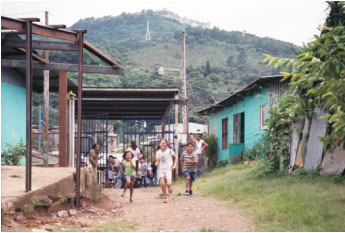 COUNTRY: Costa Rica, in Central America, where the Peninsula Rotary Club has been working since 1998. COUNTRY: Costa Rica, in Central America, where the Peninsula Rotary Club has been working since 1998.
SCHOOL: Escuela Carmen Lyra educates about 900 children in the town of Alajuelita, near San Jose. The children's ages are from kindergarten into what we would call middle school.
ENVIRONMENT: The town of Alajuelita and its inhabitants are quite poor. Many, in fact, are "undocumented" immigrants from Nicaragua, just north of Costa Rica. Although the children we saw in the school were clean and smiling, the environment around them is urban, dirty, and grim.
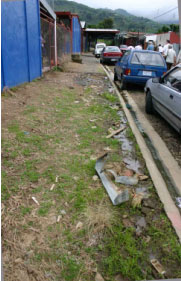 NEEDS: The school's needs were many and serious. They ranged from relatively small items such as the lack of a toilet in the kindergarten area, to larger issues such as the dangerous walkways that the children are constantly using. Various organizations promised to help, but no help came and the school staff saw little hope of improvement. NEEDS: The school's needs were many and serious. They ranged from relatively small items such as the lack of a toilet in the kindergarten area, to larger issues such as the dangerous walkways that the children are constantly using. Various organizations promised to help, but no help came and the school staff saw little hope of improvement.
BIGGEST NEED: The sewage from the entire school was being piped untreated into a nearby stream. That stream in turn was part of the water supply for the town. The danger of disease resulting from this situation was clear.
WHO IS RESPONSIBLE? The national government of Costa Rica provides very little financial help for schools. It is the local municipality that is responsible for the support of schools, and in this case the local government did not have the funds to help much.
HOW DID WE FIND OUT ABOUT THIS? Our "partner" Rotary club, the club of Escazu in Costa Rica, identified Carmen Lyra as an organization that needed help, and during one of the Peninsula Club's visits to Costa Rica the Escazu Club took us to see the school.
CONCEPT: The Rotary Foundation encourages international cooperation and understanding by providing grants when Rotary Clubs in two different countries work together on a project.
OUR PROJECT: The Peninsula Rotary Club, in consultation with the Escazu Rotary Club, decided to take on Carmen Lyra's sewage treatment as a project. This was not only the most important of their needs, but in timing it needed to come first, before other projects could logically start. It was determined that $35,000 was needed for proper treatment.
FUNDING: The Peninsula Club's money was multiplied by the Matching Grants system of The Rotary Foundation. We put in $10,000. District 7600 matched this, and then The Rotary Foundation matched all of the District's money and half of our money. Thus our $10,000 became $35,000 available for the project.
WHAT WAS THE ESCAZU CLUB'S ROLE? In addition to originating the idea, they organized and administered the project and did the bookkeeping and reporting to The Rotary Foundation. In addition, the Escazu Club solved many of the smaller problems. They installed safety railings and ramps, provided a kindergarten toilet, and corrected serious drainage problems. The work, funded with their own money and through contributions they have raised in the community, amounted to about $20,000.
SIDE EFFECTS: In addition to solving the sewage problem of the school, our Carmen Lyra project had many beneficial side effects. Because the sewage treatment system was a new, innovative design, and because it was one of the largest treatment systems of any school in the country, it got national publicity. Offers of more help came from more sources. With so much improvement in the physical environment, the school administration and staff was reinvigorated and the place became lively and cheerful. So after being known as the dirtiest school in the district, Carmen Lyra in 2012 received the "Bandera Azul," or Blue Flag, a national award for providing a good environment for the children.
|



 print this page